
• Skip to primary navigation
  • Skip to main content
  • Skip to footer
Oregon Wine Industry

Oregon Wine Industry

Oregon is the third largest viniferous grape growing region in the U.S., with 463 wineries

  • s
  • About
    • Strategic Plan
    • Board Members
    • Management Team
    • Committees
    • Budget & Financials
    • Annual Report
    • Board Meetings
    • Search
  • Marketing
    • Brand Guide
    • Campaigns >
      • Oregon Wine Month
      • Oregon Wines Fly Free
      • Give Oregon Wine
    • Social Media
    • Oregon Wine Film
    • Touring Guide
    • Tasting Room Listings
    • International Marketing
    • Media Library
  • Education
    • Oregon Wine Symposium
    • Educational and Training Resources
    • Archived Recordings
    • Resource Studio Website
  • Research
    • Scientific Research >
      • Research Grant Program
      • Funded Research Library
      • IVES Technical Reviews
      • West Coast Smoke Exposure Taskforce
    • Industry Reports >
      • Vineyard & Winery Reports
      • Economic Impact Studies
      • Labor and Salary Study
      • Harvest Reports
    • Weather & Climate Forecasts
  • Events
    • Event Calendar
    • Submit a Consumer Event
    • Submit an Industry Event
  • Press
    • Press Releases
    • Press Kit
    • Media Coverage
  • Tools
    • Oregon Wine Profit Planner
    • Wine Labeling and Packaging Resources
    • Community Benchmark/WISE Academy Toolkit
    • Wildfire Smoke Toolkit
    • Immigration Enforcement Activity Toolkit
    • Tasting Room Listings
  • Opportunities
    • Marketplace
      • Browse the Marketplace
      • Post to the Marketplace
    • Media Opportunities (Calls for Wine)
    • Industry Organization Grant Program
    • Industry Awards
  • Newsletter
    • The Grapevine Newsletter Sign Up
    • Past Grapevine Newsletters
« Back to Resources

Wine Market Council Webinar Recap: A Look at Online & Direct Wine Purchasing in a New Reality

April 10, 2020 | COVID-19, Market & Industry Research, Market Insights |

On April 3, 2020 the Wine Market Council presented a webinar in two parts. The first part featured Christian Miller of Full Glass Research, who revisited previous research about online shopping and provided new context for shifting habits given the closure of tasting rooms and restaurants. The recap of this presentation with considerations for DTC-focused wineries is below.

During the second part, Danny Brager of Nielsen’s Beverage Alcohol practice shared recent retail sales trends for beer, wine and spirits since the outbreak of the pandemic in the U.S., and what to watch going forward. Insights shared during the webinar along with more recently-released Nielsen data can be found here.


Review of Past Online Shopper Habit Research

Highlights from “Changing Retail Landscape” Findings, July 2018:
This research was comprised of 50% high frequency and 50% occasional wine drinkers.

  • In mid-2018, only 29% of wine drinkers reported shopping for wine online. Therefore, 71% of wine drinkers were buying wine in person only. These habits are likely to make a dramatic shift along with other purchasing habits that are formed during the pandemic.
  • Among those who shop both on-line and in-person, the top reasons cited for choosing to shop online include: “convenience of the shopping experience,” “better price,” and “availability of the specific wine I want to buy.”
  • For the 30% who purchase wine directly from the winery, the advantages of this channel are that it’s the “most enjoyable” way to shop and that you can “buy your best quality wines” direct.

Considerations for DTC-focused wineries:

  • How can you translate winery-direct advantages, such as an enjoyable in-person experience, to someone’s online shopping experience? What personal touches can you offer (e.g. access to staff for recommendations) to bring the enjoyable experience online?
  • The battle for online share will take place based on convenience, pricing and availability of desired wines.
    • Try out your own online shopping experience and see how it compares with other online wine retailers – whether virtual retail outlets or the online version of your local grocery store. Consider shipping options and pricing, and how easy it is to navigate your selection.
    • Consider your SEO (search engine optimization) strategy in your focus markets. Individual wineries show up several pages deep into search results for “who delivers wine in [my market]?”

Highlights from “Direct to Consumer & Online Wine Purchasing” Findings, Nov. 2018
This research surveyed the Wine Opinions panel of high frequency and high involvement wine consumers.

  • Of this cohort, 61% had purchased wine online in the past year. Aside from receiving club shipments, winery website was the next most common online shopping channel.
  • Of those buying on winery websites, only 30% were not already club members of the winery. However, winery website buyers who are not club members are an attractive group with stronger online buying behavior and good winery engagement levels:
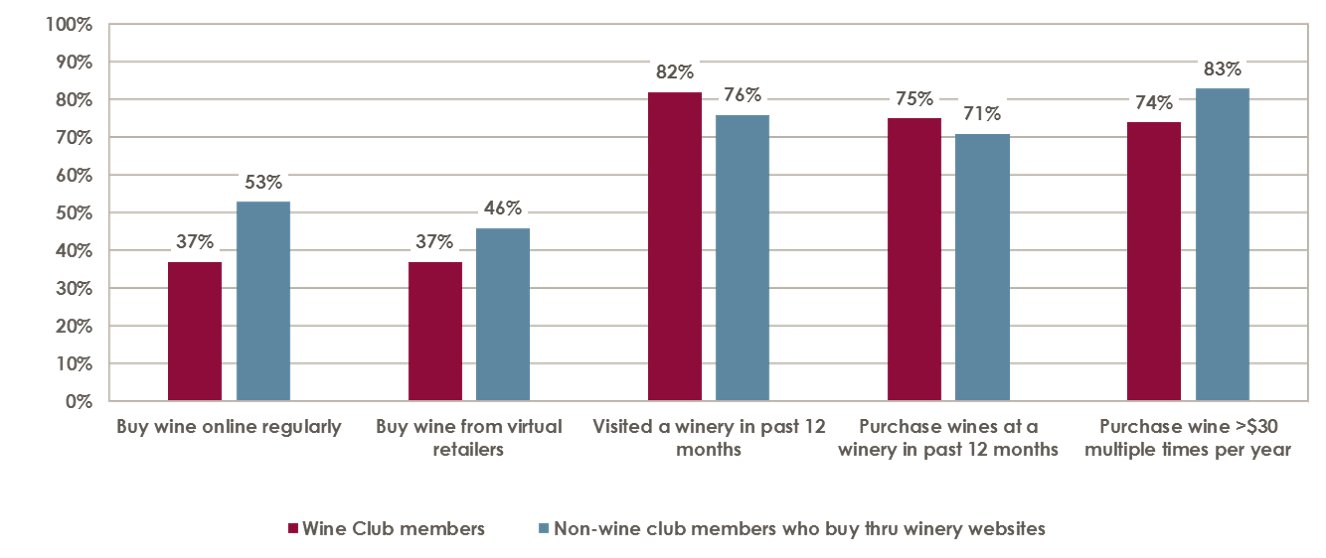
  • For those who don’t buy wine online, 65% say it’s because they like to shop in person and/or shopping in person is more convenient. 36% cite the high cost of shipping as a barriers.
  • For those who specifically don’t buy wine through winery website, 57% note the high cost of shipping / delivery.

Considerations for DTC-focused wineries:

  • While you are no doubt focusing on your club members, what percent of your mailing list is not club members? Don’t forget to engage with them thoughtfully during this time.
  • Similar to the previous study, look at how you can not only remove barriers to purchase, but also make your online experience a more personal one.

Christian offered these concluding thoughts:

Online does not just mean winery sales (online options from brick & mortar stores; online-only wine shops)
Consider your strategy to:

  • Pick up your direct share of the new wave of online buying or participate in the other online channels
  • Compete for more casual consumers and occasions – “special occasions” are
  • Conduct virtual tastings and other outreach – wine club members especially are sitting on a lot of more expensive wine, and you might encourage them to work through some of their inventory with virtual events.

DtC Sales—Tasting Room business is closed or very limited.
That leaves:

  • Club: this is your safety net, needs extra care. Memberships are vulnerable in recession as this is an optional expense for most.
  • Non-club listers: they can provide the basis for incremental sales, don’t ignore them. What do they want?
  • Local/regional club members and tasting room regulars. Identify them in your CRM system and target them specifically for local opportunities.

3-Tier Sales—Everyone is shifting to off-premise.

  • Monitor depletions tightly –cannot afford out of stocks, or you’ll lose shelf space.
  • Help and support your best retailers (check depletions data). Consider switching some of your online outreach to quality time with the trade.
  • Bricks n Clicks or Virtual Retailers –if you can’t beat them, join them.

Footer

Home

Marketing

Press

Education

Research

Contact Us

Sign up for our Newsletter

  [email protected]

  503.967.8978

Mailing Address: 
5550 S Macadam Avenue, Suite 100
Portland, OR 97239

Oregon Wine Board © 2026 | All Rights Reserved | Privacy Policy

Accessibility Adjustments

Powered by OneTap

How long do you want to hide the toolbar?
Hide Toolbar Duration
Select your accessibility profile
Vision Impaired Mode
Enhances website's visuals
Seizure Safe Profile
Clear flashes & reduces color
ADHD Friendly Mode
Focused browsing, distraction-free
Blindness Mode
Reduces distractions, improves focus
Epilepsy Safe Mode
Dims colors and stops blinking
Content Modules
Font Size

Default

Line Height

Default

Color Modules
Orientation Modules
Manage Consent
To provide the best experiences, we use technologies like cookies to store and/or access device information. Consenting to these technologies will allow us to process data such as browsing behavior or unique IDs on this site. Not consenting or withdrawing consent, may adversely affect certain features and functions.
Functional Always active
The technical storage or access is strictly necessary for the legitimate purpose of enabling the use of a specific service explicitly requested by the subscriber or user, or for the sole purpose of carrying out the transmission of a communication over an electronic communications network.
Preferences
The technical storage or access is necessary for the legitimate purpose of storing preferences that are not requested by the subscriber or user.
Statistics
The technical storage or access that is used exclusively for statistical purposes. The technical storage or access that is used exclusively for anonymous statistical purposes. Without a subpoena, voluntary compliance on the part of your Internet Service Provider, or additional records from a third party, information stored or retrieved for this purpose alone cannot usually be used to identify you.
Marketing
The technical storage or access is required to create user profiles to send advertising, or to track the user on a website or across several websites for similar marketing purposes.
  • Manage options
  • Manage services
  • Manage {vendor_count} vendors
  • Read more about these purposes
View preferences
  • {title}
  • {title}
  • {title}
Manage Consent
To provide the best experiences, we use technologies like cookies to store and/or access device information. Consenting to these technologies will allow us to process data such as browsing behavior or unique IDs on this site. Not consenting or withdrawing consent, may adversely affect certain features and functions.
Functional Always active
The technical storage or access is strictly necessary for the legitimate purpose of enabling the use of a specific service explicitly requested by the subscriber or user, or for the sole purpose of carrying out the transmission of a communication over an electronic communications network.
Preferences
The technical storage or access is necessary for the legitimate purpose of storing preferences that are not requested by the subscriber or user.
Statistics
The technical storage or access that is used exclusively for statistical purposes. The technical storage or access that is used exclusively for anonymous statistical purposes. Without a subpoena, voluntary compliance on the part of your Internet Service Provider, or additional records from a third party, information stored or retrieved for this purpose alone cannot usually be used to identify you.
Marketing
The technical storage or access is required to create user profiles to send advertising, or to track the user on a website or across several websites for similar marketing purposes.
  • Manage options
  • Manage services
  • Manage {vendor_count} vendors
  • Read more about these purposes
View preferences
  • {title}
  • {title}
  • {title}