
Introduction to the Study and Research Team
The Oregon Wine Board (OWB) has commissioned similar studies quantifying the economic impact of Oregon’s wine grape and wine-producing industries in Oregon in the years 2005, 2010, 2013, 2016, 2019 & 2020 (were combined), 2022, and now 2024. For this 2024 edition, Economic Forensics and Analytics (EFA) is again the lead consultant, with Full Glass Research (FGR) providing guidance and industry modeling when needed (FGR has been involved since this report’s 2005 edition).
This report focuses on a “multiplier” effect from wine-related businesses and their employees. Incomes generated by wineries and vineyards come from selling commodities (grapes) and products (bottled and bulk wine after grapes are processed), workers spending their wages, and vendors generating revenues that become more wages and spending. We will see in this report that Oregon’s wine industry continues to create more income for businesses, households, and government through a mix of core and allied industry changes.
Executive Summary
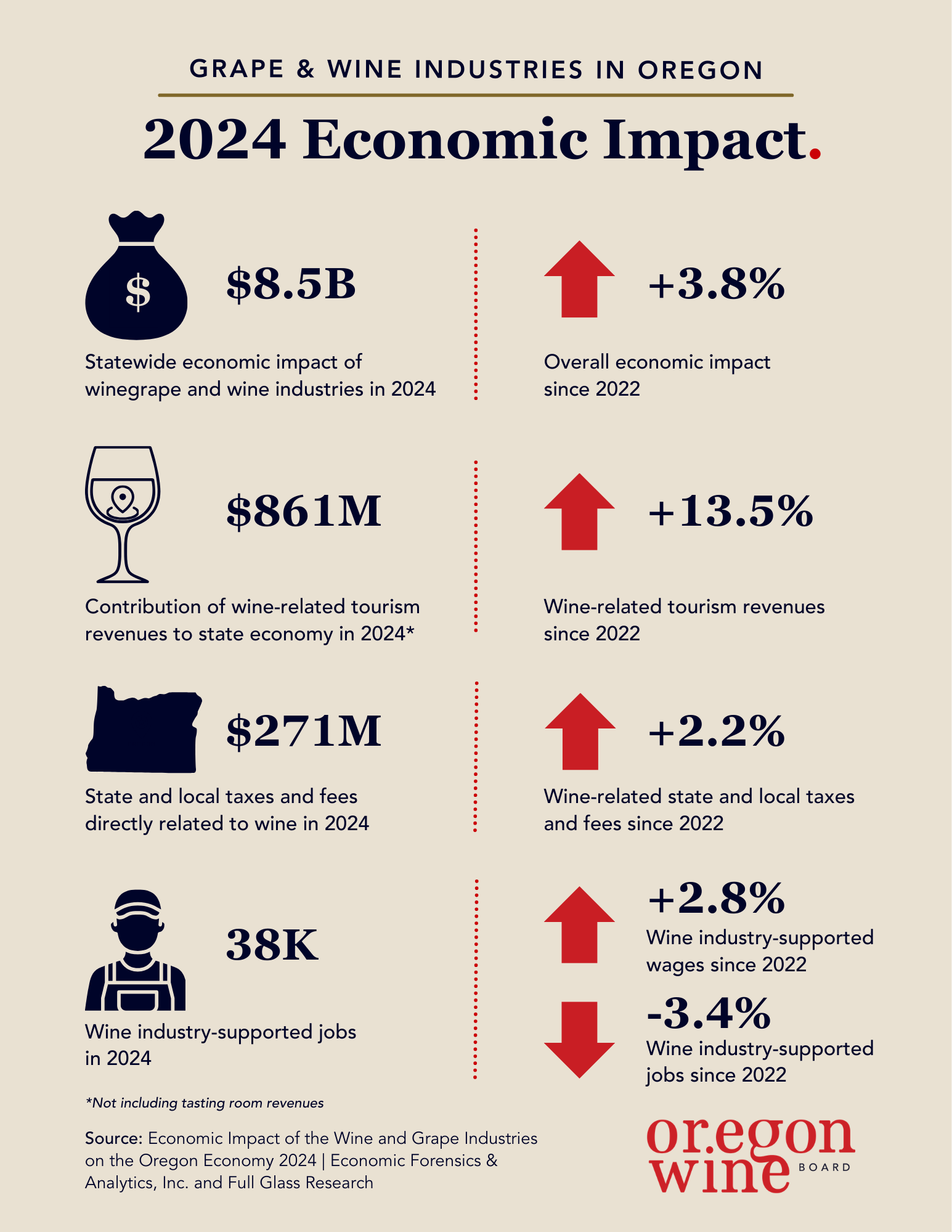
Oregon’s wine industry generated an estimated $8.487 billion economic impact in 2024. In 2022, the sum was $8.177 billion (+3.8 percent in 2024). Growth in the industry has continued since 2022, though at a slower pace than from 2019 to 2022 (+12.9 percent growth as estimated in the previous report). Many headwinds confront the industry as it looks toward 2030. Oregon wine is still in the shadow of both the pandemic and recent wildfires; the state’s wine industry is also affected by broader shifts in wine demand and by federal policy changes, such as uncertainty around tariffs and immigration enforcement, which affect both the costs of doing business and household costs in Oregon. Estimated revenues, wages, and taxes are in current dollars and not adjusted for inflation. In 2024, estimated wine-related jobs in Oregon totaled 38,088, down by 1,349 jobs from 2022; related wages totaled $1.747 billion, 2.8 percent higher than wages and salaries paid in 2022.
Key findings include:
- Over 1,535 Oregon wine grape growers produced a total crop value in 2024 of $329.1 million (including more than 610 estate vineyards), with 47,343 planted and 39,178 harvested acres.
- Planted acreage increased by 2,856 (+6.4 percent) acres from 2022 to 2024 and over 9,940 acres from 2019 to 2024;
- Harvested acreage was 1,596 fewer acres in 2024 than in 2022, in contrast.
- Approximately 129,740 tons of grapes were produced by Oregon vineyards, down 5.3 percent from 2022 (137,065 tons of grapes were produced in 2022);
- Yields were similar in 2024 to 2022, hence the decline in tonnage was primarily due to some growers leaving grapes unharvested on the vine.
- Statewide median grape prices in 2024 were approximately $2,465 per ton, up almost 4.8 percent from 2022 median prices per ton ($2,353 per ton in 2022);
- Grapes sourced in Oregon and crushed by Oregon wineries were 93,673 tons in 2024 (down from 94,426 tons in 2022);
- Pinot noir, chardonnay, and pinot gris are the most harvested grape varietals, with red varieties (weighted average price/ton of $2,738) selling for higher prices generally than white (weighted average price of $2,120/ton);
- North Willamette Valley remains the largest grape-growing region in Oregon, with almost five times the volume of South Willamette Valley; Rogue and Umpqua valleys are similar in size to South Willamette Valley.
Download graphic (PDF)
Download full report (PDF)
- Over 1,070 Oregon wineries or wine companies produced an estimated 5.717 million nine-liter (9L) equivalent cases. Oregon’s wineries sold over 5.76 million 9L equivalent cases of wine, generating revenues of over $913.2 million in 2024 from sales of packaged wine:
- Approximately 61.7 percent of 9L equivalent units were sold in other US states outside Oregon in 2024, up from 60.1 percent sold nationally in 2022, roughly offsetting an in-state decline of wholesale/retail sales of Oregon wine;
- Direct-to-consumer (DTC) sales were 18.1 percent of 9L equivalent units sold by Oregon wineries in 2024, versus 19.3 percent in 2022; tasting-room volume was 8.1 percent of the total, or 465,202 9L equivalents; tasting-room sales were lower in 2024 compared with 2022 in both percentage of total sales and 9L-equivalent volume.
Results along the supply chain included:
- Retail sales of wine in Oregon from all sources via all channels topped $1.097 billion in 2024, up 1.1 percent from 2022;
- On-premise sales revenue increased while volume decreased, primarily driven by price increases and declining wine sales in casual, lower-priced establishments;
- Off-premise revenues increased slightly, but volume declined as consumers overall reduced consumption; higher-priced wines’ share of total sales increased.
- These retail sales supported an estimated 3,546 jobs in stores and retailers, as well as 5,918 jobs in restaurants and other on-premise retail (including wine bars), up 171 jobs from 2022, but only 339 jobs in distributors and importers (down from 401 jobs in 2022).
- Wine-related activity in 2024 contributed over $270.7 million in state and local tax revenues for the state of Oregon and its municipalities ($264.8 million in state and local tax revenues in 2022 for the state of Oregon), with an estimated $111.3 million in property tax revenues (approximately 41.1 percent of total estimated tax revenues).
Visitors to Oregon are drawn to wineries across the state, especially in areas such as Yamhill and Hood River counties in 2024. Winery visitors continued post-pandemic travel in 2024; Travel Oregon estimated that out-of-state tourists visited a winery 18.8 percent of the time.
- Between 2022 and 2024, revenues from wine-related tourism increased by 13.5 percent, contributing $860.9 million to the Oregon economy from an estimated 4.137 million visitors continuing post-pandemic travel in 2024; however, estimated tourism revenues were 3.67 percent less in 2024 than in 2019, a reflection of the pandemic’s continued effects;
- Wine-related visitors supported 9,109 jobs and $329.16 million in wages in 2024. Tasting room data show that average annual visitors fell about five percent between 2022 and 2024, with 0.3 percentage points fewer conversions per visitor to tasting room sales.
Occupations in vineyards and wineries have shifted somewhat since 2022. The 2024 data show that jobs in vineyards include grounds maintenance workers, vehicle operators, and repair-shop workers. For wineries, occupations beyond winemaking and bottling facilities included tasting room workers, logistics, sales, marketing, graphic designers, and restaurant-style work. Vineyard and winery jobs may include roles that could easily be performed in other industries. This industry needs to remain competitive with statewide labor markets. Organizations such as OWB and other regional and advocacy organizations that assist in regional economic and workforce development and bring consumers to Oregon wineries (affecting direct-to-consumer possibilities, tasting room visits, and advertising generally) provided support for this report. We have made some adjustments to the 2022 totals from the previous edition based on new information as of December 2025.