
2018 was the fourth warmest year on record for the planet, and the last five years collectively are the warmest years on modern record. It was the warmest year for the world’s oceans, as well as the Arctic’s warmest year at both poles.
Similarly, it was the 8th warmest year for Oregon, and a dry year overall for the Western U.S. rain-wise, with the Northwest becoming a prime area of drought. Fires in the west continued to dominate the news. From November 2017 through October 2018, Oregon experienced a warm November, followed by a cold December and a warm January 2018. February and March cooled down and brought enough rain that both slowed the vines down and provided enough soil moisture going into spring. May, June, July and August were very warm statewide, as high as 6.3 degrees in Milton-Freewater above average for those months.
According to climatologist and director of the Evenstad Center for Wine Education at Linfield College Dr. Greg Jones, in four key winegrowing areas around the state—Roseburg, McMinnville, Milton-Freewater and Medford—the growing season experienced temperatures 1.4 to 2.3 degrees above normal. The warmer temperatures resulted in heat accumulation that was roughly 5% above average for the 2018 vintage in the four regions mentioned above. For precipitation, there was below average rainfall throughout the year with the dormant season 1 to 43% below and the growing season experiencing 14 to 58 % below average rainfall.

While wildfires burned in southern Oregon in July and then British Columbia and eastern Washington in August, some worried the grapes would be smoke-affected. Growers in the Rogue Valley were informed that an important customer was unexpectedly rejecting their fruit due to the potential for fire-smoke characteristics. King Estate Winery and Willamette Valley Vineyards sprang into action and tested and purchased as much stranded wine grapes as possible, paying the full contracted rates to help the growers. They were joined by Silvan Ridge Winery and The Eyrie Vineyards to collaboratively make a Rogue Valley AVA-labeled Pinot Noir, Chardonnay and Rosé of Pinot Noir called Oregon Solidarity.
The coalition was able to purchase more than 140 tons of grapes at a cost of $323,750 from six growers, coordinating harvest and delivery to the four participating wineries, translating to nearly 7,500 cases of wine. And the taste? Said Michael Alberty, wine columnist for the Oregonian: “The palate is nice and creamy, with more than enough acidity to keep everything interesting.Wet ashtray? Quite the opposite: Cooperation tastes mighty fine…”
Vintage Observations
While it was a warmer than average vintage, temperatures stayed in the low to mid 90s with few heat spikes, making for a balanced year with less widespread heat stress like in years’ prior, especially 2017. Low rainfall during late September and into October allowed winemakers to easily manage harvest, picking grapes when they wanted to, instead of dodging rain or having to pull fruit early. When moderately warm days occur along with cool nights, vines can rest in the evening and concentrate efforts on developing more fruit complexity and flavors. Ideal conditions like this occurred throughout Oregon in 2018.
Late bud break was due to a slightly wet and cooler April in 2018. Bloom in verasion caught up quickly and was close to average across the state. While there was low bird pressure, there were enormous amounts of yellow jackets, which points to a mild winter with temperatures not cold enough to keep the insect populations down.
Harvest was slow and steady in Oregon resulting in truly dialed in fruit composition with sugar levels, acidity, and pH all close to average. Preliminary data from vineyards around the state indicates that production numbers will likely be up 5 to 15% over 2017.
As of February 2019, Oregon has higher snowpack than we had last winter, with the eastern part of the state much higher. However, drought conditions in Oregon and the Pacific Northwest are still in place but could be lessened with a wet spring. A warm North Pacific and weak El Nino hints that 2019 will likely be one of the hottest years on record; likely ending up in top five globally. Regionally, the Pacific NW is forecast to be warmer and drier than average for the growing season.
Bree Stock MW, Oregon Wine Board Education Manager said: “The 2018 vintage in the Willamette Valley and Oregon overall is looking to make some exceptional wines. Not exactly a return to normal, as the spring and summer were some of the warmest and driest on record, but there were no real heat spikes and the season was longer due to the cool autumn weather. That allowed grapes to hang and develop complex flavors on the vine while retaining fresh acidity.”
Regional Overviews
The Columbia Gorge
While the past harvest season in 2017 faced high late summer temperature spikes causing some issues with berry development and haziness, summer in 2018 experienced long periods of sustained heat.
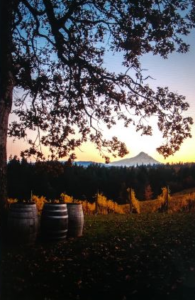
From Bob Morus, Owner of Phelps Creek Vineyards, Hood River, Oregon: “The season proceeded slightly compressed due to a stretch of mid-summer heat. Harvest began late September with ideal conditions of sunny skies, cool days and cold nights—allowing fruit to ripen incrementally. Ultimately the vintage might sear into memory for its stunningly long, beautiful fall encompassing most of October. The season made you feel blessed to live in Oregon.”
Eastern Oregon
From Sadie Drury, Vineyard Manager, North Slope Management and Seven Hills Vineyard, Pambrun. Walla Walla: “2018 was a memorable vintage from start to finish in the Walla Walla AVA. The vines eased into dormancy and no sub-zero temperatures were seen in the winter of 2017-2018. We saw “normal” bud break dates at Seven Hills Vineyard, similar to the 2013, 2014, and 2017 vintages. Warm and consistent weather created a very even bud break. There were minimal spring frost threats post-bud break. The warm and consistent temperatures maintained through May, which brought a slightly early, but very even bloom. The prime weather conditions created excellent fruit set in all cultivars and clones which set Walla Walla up for a slightly heavy harvest. After fruit set, temperatures cooled to slightly below average, slowing down degree day accumulation and setting up the vines for excellent and stress-free growing conditions. Despite the cooler-than-average summer temperatures, there was no precipitation for months allowing growers to easily control canopies and have little mildew pressure. Due to the even bud break and bloom with consistent temperatures, very even veraison and ripening was also seen. Temperatures remained cooler than normal through harvest, allowing for extra hang time without high sugar accumulation. Some people are calling 2018 “the unicorn vintage.'”
Southern Oregon
Fire and smoke were large issues across the region, affecting air quality but also maximum and minimum temperatures by lowering solar radiation during the day but insulating during the evening. The Umpqua Valley didn’t have as much smoke as the Rogue; however, the maximum temperatures in the Umpqua were higher than the Rogue Valley, which is nearly always warmer, showing an issue of smoke moderating the temperatures in those two locations.
In the Register Guard, Stephen Reustle, owner of Reustle- Prayer Rock Vineyards in the foothills of the Umpqua Valley near Roseburg, was quoted as saying, “This is the best year I’ve ever experienced. The 2018 vintage was a wine-maker’s dream, providing near-perfect numbers for sugar, pH and acidity. The quality of the fruit is beyond anything I’ve tasted, and that’s already showing in wine now in the barrel.”
Concerned with the smoke from fires affecting visitors to the region, Travel Southern Oregon (TSO) designed a study to explore visitors’ perception of Southern Oregon as a desirable travel destination and that 85 % of visitors said they plan to visit Southern Oregon in the future.
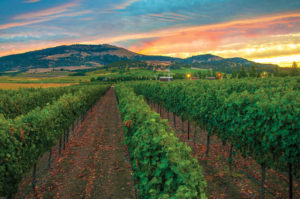
More anecdotal info on the Willamette Valley’s 2018 harvest include views by Stewart Bodecker of Boedecker Cellars, who said, “What a vintage it was! Even measured in the context of a string of great vintages, 2018 wines stand out as pretty phenomenal. While fruit showed perhaps darker/juicier flavor profiles when compared to the 2017 vintage, the wines still exhibit the typical brightness and balance between freshness and depth of fruit that are hallmarks of Oregon wine. These wines show structure both from good acidity and from some really elegant tannins, and there’s a sexiness to the fruit profile that’s appealing already. We’re very, very excited to watch them mature.”
-Compiled by Sally Murdoch, OWB, and Dr. Greg Jones, Climatologist and Director of the Evenstad Center for Wine Education at Linfield College