
• Skip to primary navigation
  • Skip to main content
  • Skip to footer
Oregon Wine Industry

Oregon Wine Industry

Oregon is the third largest viniferous grape growing region in the U.S., with 463 wineries

  • s
  • About
    • Strategic Plan
    • Board Members
    • Management Team
    • Committees
    • Budget & Financials
    • Annual Report
    • Board Meetings
    • Search
  • Marketing
    • Brand Guide
    • Campaigns >
      • Oregon Wine Month
      • Oregon Wines Fly Free
      • Give Oregon Wine
    • Social Media
    • Oregon Wine Film
    • Touring Guide
    • Tasting Room Listings
    • International Marketing
    • Media Library
  • Education
    • Oregon Wine Symposium
    • Educational and Training Resources
    • Archived Recordings
    • Resource Studio Website
  • Research
    • Scientific Research >
      • Research Grant Program
      • Funded Research Library
      • IVES Technical Reviews
      • West Coast Smoke Exposure Taskforce
    • Industry Reports >
      • Vineyard & Winery Reports
      • Economic Impact Studies
      • Labor and Salary Study
      • Harvest Reports
    • Weather & Climate Forecasts
  • Events
    • Event Calendar
    • Submit a Consumer Event
    • Submit an Industry Event
  • Press
    • Press Releases
    • Press Kit
    • Media Coverage
  • Tools
    • Oregon Wine Profit Planner
    • Wine Labeling and Packaging Resources
    • Community Benchmark/WISE Academy Toolkit
    • Wildfire Smoke Toolkit
    • Immigration Enforcement Activity Toolkit
    • Tasting Room Listings
  • Opportunities
    • Marketplace
      • Browse the Marketplace
      • Post to the Marketplace
    • Media Opportunities (Calls for Wine)
    • Industry Organization Grant Program
    • Industry Awards
  • Newsletter
    • The Grapevine Newsletter Sign Up
    • Past Grapevine Newsletters

2022 Economic Impact of the Wine and Wine Grape Industries on the Oregon Economy

The Oregon vineyard and wine industry’s new Economic Impact Report shows continued growth and increased contribution to the state’s economy

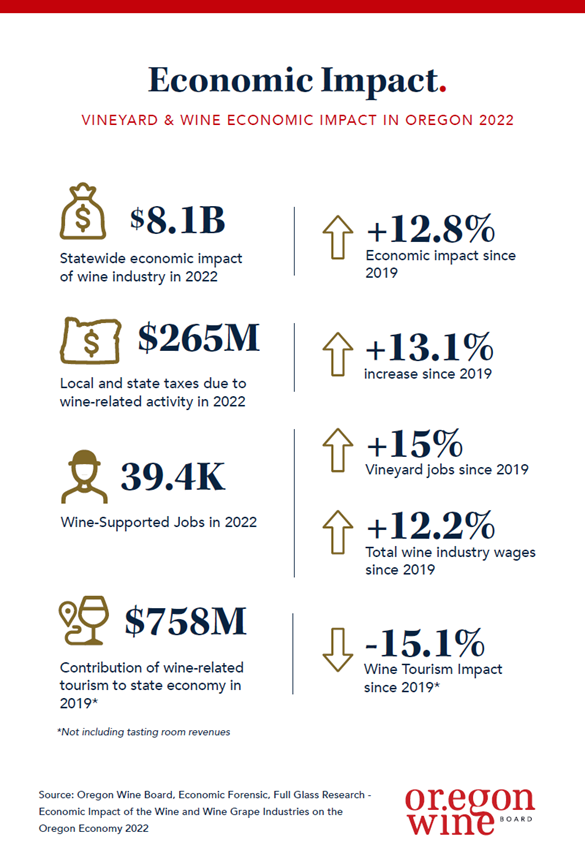
With an $8 billion economic impact, Oregon’s vineyards and wine businesses continue to be an economic driver deeply rooted in the state’s agriculture, offering high-value tourism experiences despite fewer tasting room visits.

PORTLAND, OR, March 27, 2024  — The economic contributions grape growing and wine industries make to Oregon grew almost $1 billion from 2019 to 2022, according to the new report released today by the Oregon Wine Board. Conducted by Dr. Robert Eyler of Economic Forensics and Analytics, Inc. and Christian Miller, proprietor of Full Glass Research, the Economic Impact Report is published every three years. The report provides a snapshot of every grape and wine industry tier that contributed to the overall economy. The wide breadth and depth of data present a complete and accurate estimate of Oregon’s wine industry’s economic impact. However, the report is based on 2022 data and can be supplemented with more recent (2023) studies on wine industry sales.
“Oregon’s wine industry continues to create more income for businesses, households, and government through a mix of core and allied industries,” said Gina Bianco, Executive Director of the Oregon Wine Board. “Due to the quality, desirability, and price point of Oregon wines, we continue to be more resilient and outperform other wine regions in major retail store channels.”

Wine-supported job wages soared 12.2%, due to both inflation and a shift to a more skilled workforce. At the same time, overall employment supported by the wine industry was down 1.5%. The total number of jobs supported by Oregon’s wine industry was just under 40K and remained stable. The category that grew the largest was vineyard stewards, which increased by 15%, aligning with the upward trend in planted acreage.

Also, fewer visitors went to Oregon’s tasting rooms in 2022. The authors write, “the pandemic’s shadow remains on Oregon’s economy and wine industry, though it is fading.” Using Community Benchmark data, researchers concluded that the average number of visitors per winery was down 36% from 2019. Wine-supported tourism accounted for $758 million in statewide revenues through lodging, dining, and other activities (not including sales from tasting rooms counted in the winery revenue section). Overall, wine tourism saw a 15.1% decrease from 2019 spending of $893 million.

Eyler notes in the report, “Sales increased as wholesalers replenished inventories, but in 2022, wine sales in all tiers, from wineries to retail, began to decline. Two major forces are at work: (1) pandemic impacts on trade and consumer behavior; (2) shifts in consumer preferences related to wine. Oregon wines were more resilient than those from many other regions because their production is concentrated in the more in-demand price segments and varieties, and many were able to adapt to channel shifting by boosting club and online sales and expanding direct-to-trade and local consumer sales”.

The consumers who did make it to tasting rooms bought more premium-priced wines, resulting in higher expenditures per winery visitor. In the report, Miller referred to this as a “trading up” phenomenon, in which fewer visitors were buying fewer bottles but choosing more expensive ones, with 72% of visitors to tasting rooms making purchases.

The table below illustrates this phenomenon by showing an increase in tasting room revenues despite a decrease in case sales volume between 2019 and 2022.


Measure 2019 2022
Total TR revenues 173,009,188 247,848,160
Total TR cases sold 532,807 497,393

With state and local taxes at $265 million, property value increase caused a rise in taxes revenues of 13.1%.

At the 2024 Oregon Wine Symposium, Eyler pointed to forces that continue to affect the wine industry, including public policy trends, high interest rates, and resilience wearing thin as the industry navigated headwinds over the past few years. Inflation’s impact on U.S. households has continued to affect retail sales, as those who once stocked up on wine six times a year are now buying less volume and with less frequency.

# # #

About the Oregon Wine Board:

The Oregon Wine Board is a semi-independent Oregon state agency managing marketing, research, and education initiatives that support and advance the Oregon wine and wine grape industry. The Board works on behalf of all Oregon wineries and independent growers throughout the state’s diverse winegrowing regions. To learn more, visit industry.oregonwine.org

March 28, 2024 | Press Room |

Footer

Home

Marketing

Press

Education

Research

Contact Us

Sign up for our Newsletter

  [email protected]

  503.967.8978

Mailing Address: 
5550 S Macadam Avenue, Suite 100
Portland, OR 97239

Oregon Wine Board © 2026 | All Rights Reserved | Privacy Policy

Accessibility Adjustments

Powered by OneTap

How long do you want to hide the toolbar?
Hide Toolbar Duration
Select your accessibility profile
Vision Impaired Mode
Enhances website's visuals
Seizure Safe Profile
Clear flashes & reduces color
ADHD Friendly Mode
Focused browsing, distraction-free
Blindness Mode
Reduces distractions, improves focus
Epilepsy Safe Mode
Dims colors and stops blinking
Content Modules
Font Size

Default

Line Height

Default

Color Modules
Orientation Modules
Manage Consent
To provide the best experiences, we use technologies like cookies to store and/or access device information. Consenting to these technologies will allow us to process data such as browsing behavior or unique IDs on this site. Not consenting or withdrawing consent, may adversely affect certain features and functions.
Functional Always active
The technical storage or access is strictly necessary for the legitimate purpose of enabling the use of a specific service explicitly requested by the subscriber or user, or for the sole purpose of carrying out the transmission of a communication over an electronic communications network.
Preferences
The technical storage or access is necessary for the legitimate purpose of storing preferences that are not requested by the subscriber or user.
Statistics
The technical storage or access that is used exclusively for statistical purposes. The technical storage or access that is used exclusively for anonymous statistical purposes. Without a subpoena, voluntary compliance on the part of your Internet Service Provider, or additional records from a third party, information stored or retrieved for this purpose alone cannot usually be used to identify you.
Marketing
The technical storage or access is required to create user profiles to send advertising, or to track the user on a website or across several websites for similar marketing purposes.
  • Manage options
  • Manage services
  • Manage {vendor_count} vendors
  • Read more about these purposes
View preferences
  • {title}
  • {title}
  • {title}
Manage Consent
To provide the best experiences, we use technologies like cookies to store and/or access device information. Consenting to these technologies will allow us to process data such as browsing behavior or unique IDs on this site. Not consenting or withdrawing consent, may adversely affect certain features and functions.
Functional Always active
The technical storage or access is strictly necessary for the legitimate purpose of enabling the use of a specific service explicitly requested by the subscriber or user, or for the sole purpose of carrying out the transmission of a communication over an electronic communications network.
Preferences
The technical storage or access is necessary for the legitimate purpose of storing preferences that are not requested by the subscriber or user.
Statistics
The technical storage or access that is used exclusively for statistical purposes. The technical storage or access that is used exclusively for anonymous statistical purposes. Without a subpoena, voluntary compliance on the part of your Internet Service Provider, or additional records from a third party, information stored or retrieved for this purpose alone cannot usually be used to identify you.
Marketing
The technical storage or access is required to create user profiles to send advertising, or to track the user on a website or across several websites for similar marketing purposes.
  • Manage options
  • Manage services
  • Manage {vendor_count} vendors
  • Read more about these purposes
View preferences
  • {title}
  • {title}
  • {title}